
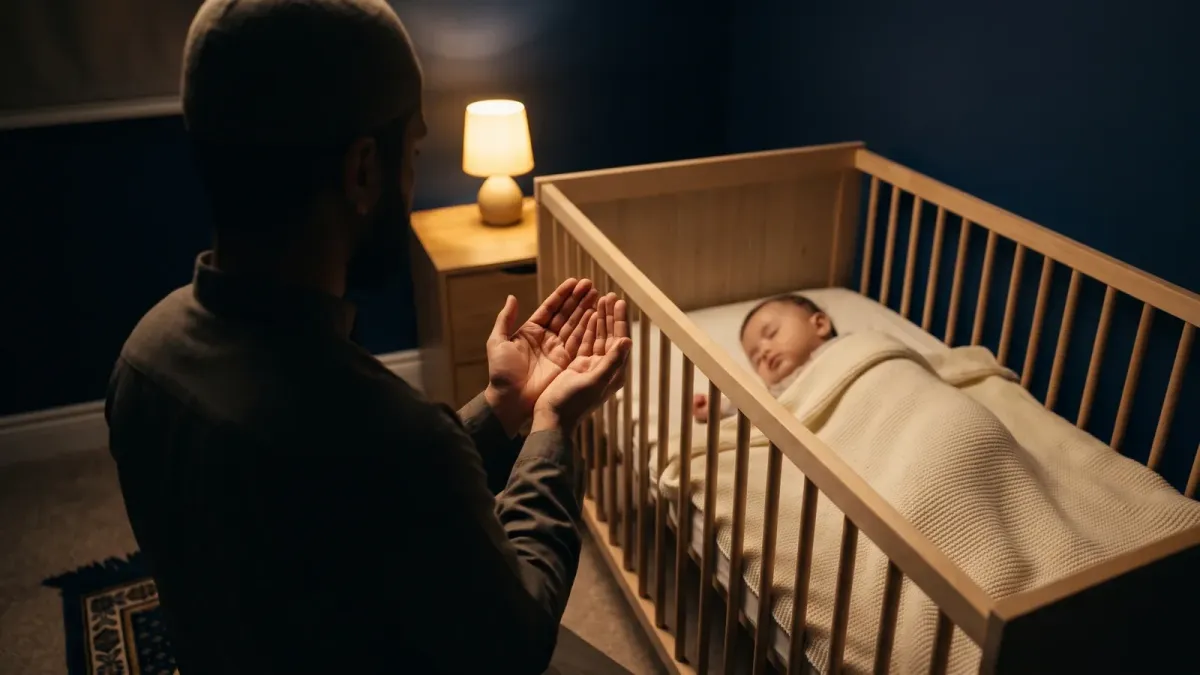
Dua for Protection from the Evil Eye (Nazar): The Sunnah Way
The evil eye is real, and the Prophet ﷺ himself taught his household the words to say against it. If you have felt a heaviness settle over the home after praise, or over a child after a stranger stared, the first thing to reach for is not a remedy someone has invented but the dua for protection from the evil eye that the Prophet ﷺ used for the two he loved most. This guide sets out the authentic surahs and duas for nazar from the Qur'an and the Sunnah, and how to fold them into the day for yourself and for your children.
Why protection from the evil eye matters
The evil eye, called al-'ayn in Arabic and nazar in South Asian usage, is not folklore. It is established in the words of the Prophet ﷺ himself. He said, "The evil eye is real, and if anything were to overtake the divine decree, it would be the evil eye" (Sahih Muslim 2188). In another narration collected by al-Bukhari, he said plainly, "The influence of an evil eye is a fact" (Sahih al-Bukhari 5740).
الْعَيْنُ حَقٌّ، وَلَوْ كَانَ شَيْءٌ سَابَقَ الْقَدَرَ سَبَقَتْهُ الْعَيْنُ
“The evil eye is real, and if anything were to overtake the divine decree it would be the evil eye.”
Ibn ‘Abbas · Sahih Muslim
Protection from it, therefore, is not a superstition to be indulged. It is a Sunnah to be practised. The Muslim who guards their tongue when they admire something, and guards their home with the recitation of the Qur'an, is doing what the Prophet ﷺ taught his own family to do. If the wider context is new to you, our article on understanding the evil eye in Islam covers what it is, how it works by the permission of Allah, and what the Sunnah says about causing it as well as suffering from it.
The core surahs: Al-Falaq, An-Nas and Ayat al-Kursi
Three passages of the Qur'an sit at the heart of protection recitation, and every serious dua for evil eye protection begins with them.
Surah Al-Falaq (113)
Al-Falaq is a surah of seeking refuge, and one of its verses names the envier directly: "And from the evil of an envier when he envies" (113:5). It also seeks refuge from "the evil of what He has created", "the evil of the darkening night when it comes", and "the evil of those who blow on knots". This is Allah teaching His Messenger, and through him teaching us, the exact refuge to reach for.
وَمِن شَرِّ حَاسِدٍ إِذَا حَسَدَ
“And from the evil of an envier when he envies.”
Surah Al-Falaq · Qur’an 113:5
Surah An-Nas (114)
An-Nas seeks refuge with the Lord of mankind from the whisperer who withdraws and whispers in the chests of people, whether from the jinn or from mankind. Recited alongside Al-Falaq, the two are known as the Mu'awwidhatayn, the two surahs of refuge. The Prophet ﷺ used them as protection, and after they were revealed he adopted them and set aside what he had used before, as narrated by Abu Sa'id al-Khudri (may Allah be pleased with him) and collected by At-Tirmidhi in his Sunan.
Ayat al-Kursi (2:255)
Ayat al-Kursi is the greatest verse of the Qur'an. The Prophet ﷺ told Ubayy ibn Ka'b that it is the greatest verse in the Book of Allah (Sahih Muslim 810). Reciting it before sleep and after every obligatory prayer is part of the daily protection every Muslim can hold on to. It carries the reality of Allah's dominion over everything in the heavens and the earth, and that is exactly the reality an envier's glance is powerless against by the permission of Allah.
The Prophetic dua for children and household
The single most important dua for protection from the evil eye for a child comes from the practice of the Prophet ﷺ himself. Ibn Abbas (may Allah be pleased with him) narrated that the Prophet ﷺ used to seek refuge for al-Hasan and al-Husayn with these words:
U'idhukuma bikalimatillahit-tammati, min kulli shaytanin wa hammah, wa min kulli 'aynin lammah.
"I seek refuge for you both in the perfect words of Allah, from every devil and every crawling creature, and from every envious evil eye" (Sahih al-Bukhari). He would add, "Your father Ibrahim used to seek refuge with these very words for Isma'il and Ishaq."
أُعِيذُكُمَا بِكَلِمَاتِ اللَّهِ التَّامَّةِ، مِنْ كُلِّ شَيْطَانٍ وَهَامَّةٍ، وَمِنْ كُلِّ عَيْنٍ لَامَّةٍ
“I seek refuge for you both in the perfect words of Allah, from every devil and every crawling creature, and from every envious evil eye.”
Ibn ‘Abbas · Sahih al-Bukhari
This is the Sunnah, taught to the Prophet ﷺ through the line of the prophets before him, and it is the dua a parent has been given to say over a sleeping baby, over a child leaving the house, or over any of the family at any hour. Say it three times, blowing lightly over the child after each recitation, in the way the Prophet ﷺ did.
Alongside this, the words the Prophet ﷺ taught Khawlah bint Hakim (may Allah be pleased with her) are a general protection for the whole household: A'udhu bikalimatillahit-tammati min sharri ma khalaq, "I seek refuge in the perfect words of Allah from the evil of what He has created" (Sahih Muslim 2708). The Prophet ﷺ said whoever says this three times when he stops at a place, nothing will harm him until he moves on.
أَعُوذُ بِكَلِمَاتِ اللَّهِ التَّامَّاتِ مِنْ شَرِّ مَا خَلَقَ
“I seek refuge in the perfect words of Allah from the evil of what He has created.”
Khawlah bint Hakim · Sahih Muslim
When and how often to recite: the morning and evening adhkar

Protection is not a one-off recitation after a scare. It is a rhythm the day is built around. The Prophet ﷺ set that rhythm through the morning and evening adhkar, and these are where the surahs and duas above have their permanent place.
Al-Falaq, An-Nas and Al-Ikhlas, three times each, morning and evening. Reported by Abdullah ibn Khubayb (may Allah be pleased with him), collected by At-Tirmidhi and Abu Dawud, with the Prophet ﷺ saying they suffice a person against everything.
Ayat al-Kursi after every obligatory prayer, and once before sleep. The reward and the protection for reciting it before sleep are given in the well-known hadith of Abu Hurayrah (may Allah be pleased with him) collected by al-Bukhari.
A'udhu bikalimatillahit-tammati min sharri ma khalaq, three times when leaving the house or settling in a new place. Sahih Muslim 2708, as above.
The Ibn Abbas dua over each child, at least at night before sleep. Sahih al-Bukhari, as above.
None of these need to be memorised on the same day. Add one at a time, and hold it. A short list said consistently is worth far more than a long list said once. For the wider set of protective recitations and how they fit together, see our guide to surahs for protection in Islam.
Guarding the tongue: the Prophetic manners of praise
The Prophet ﷺ did not only give a dua to say after the eye has struck. He also taught his Companions how not to strike with it in the first place. When Amir ibn Rabi'ah (may Allah be pleased with him) praised Sahl ibn Hunayf and Sahl was afflicted, the Prophet ﷺ asked, "Why does one of you kill his brother? If one of you sees something in his brother he admires, let him supplicate for barakah for him" (narrated in the Muwatta of Imam Malik and in the Musnad of Imam Ahmad; grading for the Shaykh to confirm).
The practice that comes from this is simple. When you admire a person, a child, a home or a possession, say Ma sha' Allah, la quwwata illa billah, "What Allah has willed, there is no power except with Allah", and ask Allah to bless what has been praised. That single phrase, made a habit, closes one of the most common doors to the evil eye without insulting anyone.
If the signs persist and you want deeper reading on the ruqyah steps that pair with these duas, see our full guide to ruqyah for evil eye. It walks through the Prophetic method a Raqi follows in a session, alongside what you can do yourself at home.
What to do if you fear you are already affected
If the surahs and adhkar have been part of your day and something still feels wrong, that is worth taking seriously rather than shrugging off. Signs a Raqi looks for include a persistent heaviness or unease that does not lift, unexplained tiredness or physical symptoms your doctor cannot account for, disturbance in sleep, and a felt weight over the home after a specific event or interaction. The unseen is not yours to weigh up on your own, and neither is it something to diagnose yourself into. What settles the matter is a proper assessment alongside ruling out medical causes. Our article on ruqyah for the evil eye walks through the treatment side in more detail.
Keep reciting. The Sunnah remedy for someone struck by the eye, when the one whose glance caused it is known, is the ghusl described in the hadith of Sahl ibn Hunayf: the water used by the one who envied is poured over the one afflicted. Where that is not possible, keep to the Qur'an and the authentic adhkar, and if the signs persist, seek a qualified Raqi. To understand what authentic treatment involves before you speak to anyone, see what ruqyah is according to Islam.
Book your one-to-one Zoom session
How we can help
If you have been reciting the duas and the signs are not lifting, that is the point at which a proper assessment is worth having rather than another week of guessing. Our sessions are online over Zoom, strictly one to one, led by qualified Shaykhs. We assess before we treat, across the spiritual, the emotional and the physical, so you are not treating the wrong thing for weeks on end. Where we believe the cause is medical we say so and encourage you to see a doctor alongside.
You will not be asked for a lock of hair, an item of clothing, your mother's name or your date of birth, and you will not be given an amulet to wear. What you will be given is a clear picture of what is happening and a plan you are followed on week by week, so you are never left guessing between sessions. Read more about our private one-to-one ruqyah treatment, or book directly at ruqyahtreatment.com/book-appointment.
Book your one-to-one Zoom session
Frequently asked questions
What is the best dua for protection from the evil eye?
For a child, the Prophetic dua the Prophet ﷺ said over al-Hasan and al-Husayn is the strongest starting point: A'udhu bikalimatillahit-tammati, min kulli shaytanin wa hammah, wa min kulli 'aynin lammah (Sahih al-Bukhari). For general daily protection, recite Al-Falaq and An-Nas three times each morning and evening.
Which surah is best for evil eye?
Al-Falaq (113) is the surah that names the envier directly, in the verse "and from the evil of an envier when he envies". Recited together with An-Nas (114), the two are the Mu'awwidhatayn, the surahs of refuge the Prophet ﷺ used and taught to his household. Ayat al-Kursi (2:255) is added for protection before sleep and after each obligatory prayer.
How do I protect my child from nazar?
Recite the Ibn Abbas dua over the child, blowing lightly after each of three recitations. Hold to the morning and evening adhkar in the home, and teach the child Al-Falaq and An-Nas as soon as they can memorise them. Say Ma sha' Allah, la quwwata illa billah when others praise the child, and ask them to say the same.
Can dua on its own remove the evil eye?
By the permission of Allah, dua and the recitation of the Qur'an are the means Allah has given. Shifa belongs to Allah alone, and no one guarantees an outcome. Where the signs persist despite consistent recitation, a proper assessment with a qualified Raqi is the next step, alongside seeing a doctor for anything that could be medical.
Is it Sunnah to say Ma sha' Allah when admiring something?
Yes. The Prophet ﷺ, when Amir ibn Rabi'ah's praise of Sahl ibn Hunayf was followed by Sahl falling ill, taught that the one who admires should supplicate for barakah for what he sees. Saying Ma sha' Allah, la quwwata illa billah and asking Allah to bless the person or thing is the Prophetic manner of praise.
A note on medical care
Nothing here is medical advice and none of it is a diagnosis. Many of the difficulties people bring to a Raqi have ordinary medical and psychological causes, and those should be investigated with a qualified doctor. Ruqyah is a means by which Allah gives healing, and it is practised alongside medical care, never as a replacement for it. Shifa belongs to Allah alone.