Ruqyah for Children: Signs, Protection and What Parents Do
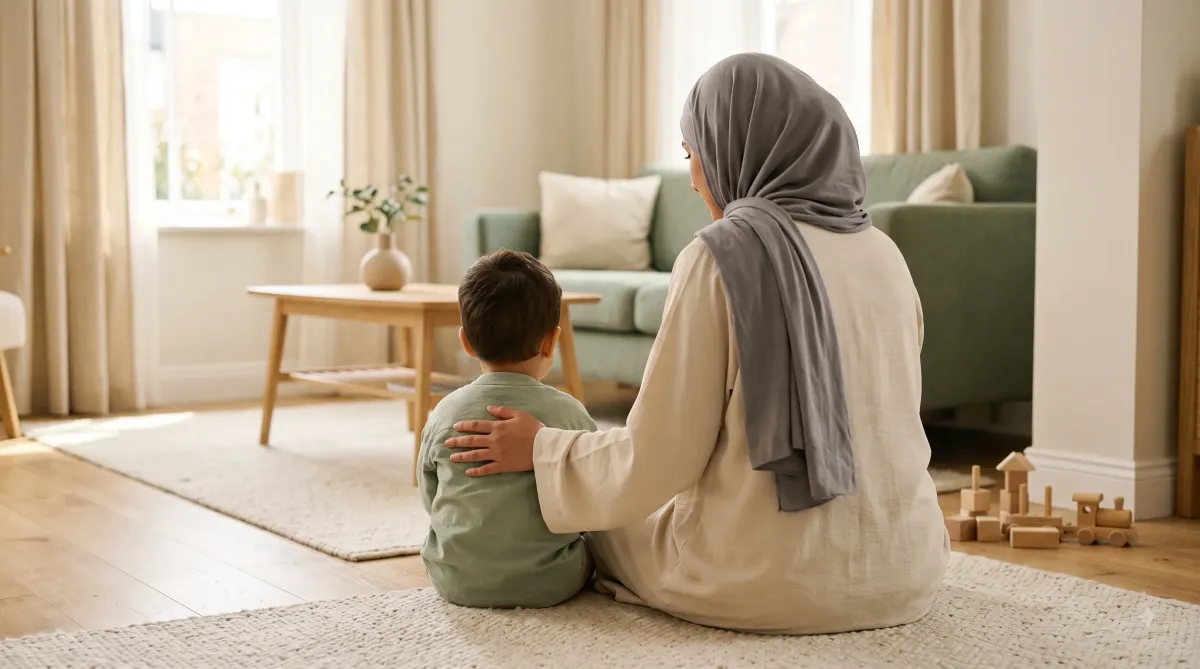
Your child is not themselves and you have started to wonder whether something more than tiredness is at play. It is a heavy thing to sit with, and you want to know what the deen says about it before you do anything. Ruqyah for children rests on the same evidence as ruqyah for adults, but it asks for a gentler hand and a clearer head. There are Sunnah protections the Prophet ﷺ sought over his own grandchildren, there are signs a parent might notice, there are medical checks that always come first, and there is a point at which it is right to speak to a qualified Raqi. None of it is a diagnosis of your child.
Children, the evil eye and affliction in the Sunnah
The evil eye is not superstition and it is not the parent's imagination. The Prophet ﷺ said plainly, "The evil eye is real" (Sahih al-Bukhari). It touches adults and it touches children, and the Sunnah takes it seriously enough to prescribe both protection and treatment for it. If the idea of ayn is new to you, our guide to understanding the evil eye in Islam sets out the evidence and how it is thought to operate.
الْعَيْنُ حَقٌّ
“The evil eye is real.”
- Abu Hurayrah · Sahih al-Bukhari
Umm Salamah (may Allah be pleased with her) narrated that the Prophet ﷺ saw in her house a young girl with a mark on her face, and he said, "She is affected by the evil eye, so seek ruqyah for her." The report is recorded by al-Bukhari in his Sahih. The instruction is direct: where the eye is suspected in a child, the response is to seek ruqyah, not to explain it away and not to panic. The healing itself is by the permission of Allah, and the recitation is a means. Shifa belongs to Allah alone. Ibrahim (peace be upon him) said of his Lord, "And when I am ill, it is He who cures me" (Surah ash-Shu'ara, 26:80). The same is true when the one who is unwell is our child.
بِهَا نَظْرَةٌ، فَاسْتَرْقُوا لَهَا
“She is affected by the evil eye, so seek ruqyah for her.”
- Umm Salamah · Sahih al-Bukhari
Signs a parent might notice, and why the doctor comes first
Before anything else: if your child is unwell, take them to a doctor. This is the first and firmest step, and it does not conflict with the deen in any way. Many of the things that worry a parent have ordinary medical or developmental causes, and those deserve to be investigated properly by someone qualified to investigate them. Ruqyah sits alongside qualified medical care, never in place of it.
The list below is not a checklist and it is not a diagnostic tool. It is what we see across twenty years of practice, in cases where families eventually came to us after the medical picture had been ruled out. The Islamic ruling on the unseen is that it belongs to Allah, and no parent can weigh up on their own whether a child is affected. That is a Raqi's assessment, not a search-engine one.
A settled child becoming persistently unsettled without a change in their circumstances.
Sleep that will not come, or that breaks night after night with distress that is hard to soothe.
Feeding that has become difficult in a way the doctor cannot account for.
A change in mood or behaviour that has arrived quickly and does not lift.
A recurring, sudden fear or crying, particularly at the same time of night, that has no ordinary trigger.
Every one of these can be, and most often is, something else entirely. Teething, a growth spurt, a new sibling, the start of school, a subtle illness the family has not yet spotted. A doctor should have the first look, and where a doctor finds a cause, that is the cause. It is only after the medical picture is clear and the difficulty is still there that it is right to consider a spiritual assessment.
How the Prophet ﷺ sought protection for children
The Sunnah shows the Prophet ﷺ actively seeking refuge for his grandchildren. Ibn Abbas (may Allah be pleased with him) narrated that the Prophet ﷺ used to seek refuge for al-Hasan and al-Husayn (may Allah be pleased with them) with these words: "A'udhu bi kalimati'llahi t-tammati, min kulli shaytanin wa hammatin, wa min kulli 'aynin lammah." "I seek refuge for you both in the perfect words of Allah from every devil, from every harmful creature, and from every evil eye." He said that Ibrahim (peace be upon him) used to seek refuge in the same way for Isma'il and Ishaq (peace be upon them). The report is in Sahih al-Bukhari.
أُعِيذُكُمَا بِكَلِمَاتِ اللَّهِ التَّامَّةِ، مِنْ كُلِّ شَيْطَانٍ وَهَامَّةٍ، وَمِنْ كُلِّ عَيْنٍ لَامَّةٍ
“I seek refuge for you both in the perfect words of Allah, from every devil and every crawling creature, and from every envious evil eye.”
- Ibn ‘Abbas · Sahih al-Bukhari
The wording sits inside a settled Prophetic pattern. The Prophet ﷺ himself sought refuge with the words of Allah from the harms of the unseen and taught his household to do the same. A parent doing this over their child is on the same Sunnah. It is not new, it is not innovation, and it does not require any special standing to say. Our post on the duas for protection from the evil eye covers the wording of these supplications and their sources in detail.
Daily protection: the adhkar to recite over a child
Daily protection is the ordinary Sunnah of a Muslim home. It does not require anything unusual, only that the parents make a habit of it and keep it up. The Qur'an itself is described as a healing: "And We send down of the Qur'an that which is a healing and a mercy for the believers" (Surah al-Isra, 17:82). The following are the well-known Sunnah protections a parent can recite for their child.
Surah al-Falaq (113) and Surah an-Nas (114), the Mu'awwidhatayn, the two surahs of seeking refuge. Both were sent down in seeking refuge from harm, and both are recited by Muslims morning and evening as part of the daily adhkar.
Ayat al-Kursi (Surah al-Baqarah, 2:255), recited in the daily adhkar and before sleep.
The Prophetic dua for seeking refuge for a child: "A'udhu bi kalimati'llahi t-tammati, min kulli shaytanin wa hammatin, wa min kulli 'aynin lammah", as above.
The morning and evening adhkar as an ordinary daily rhythm, said by the parent and, when they are old enough, learned by the child.
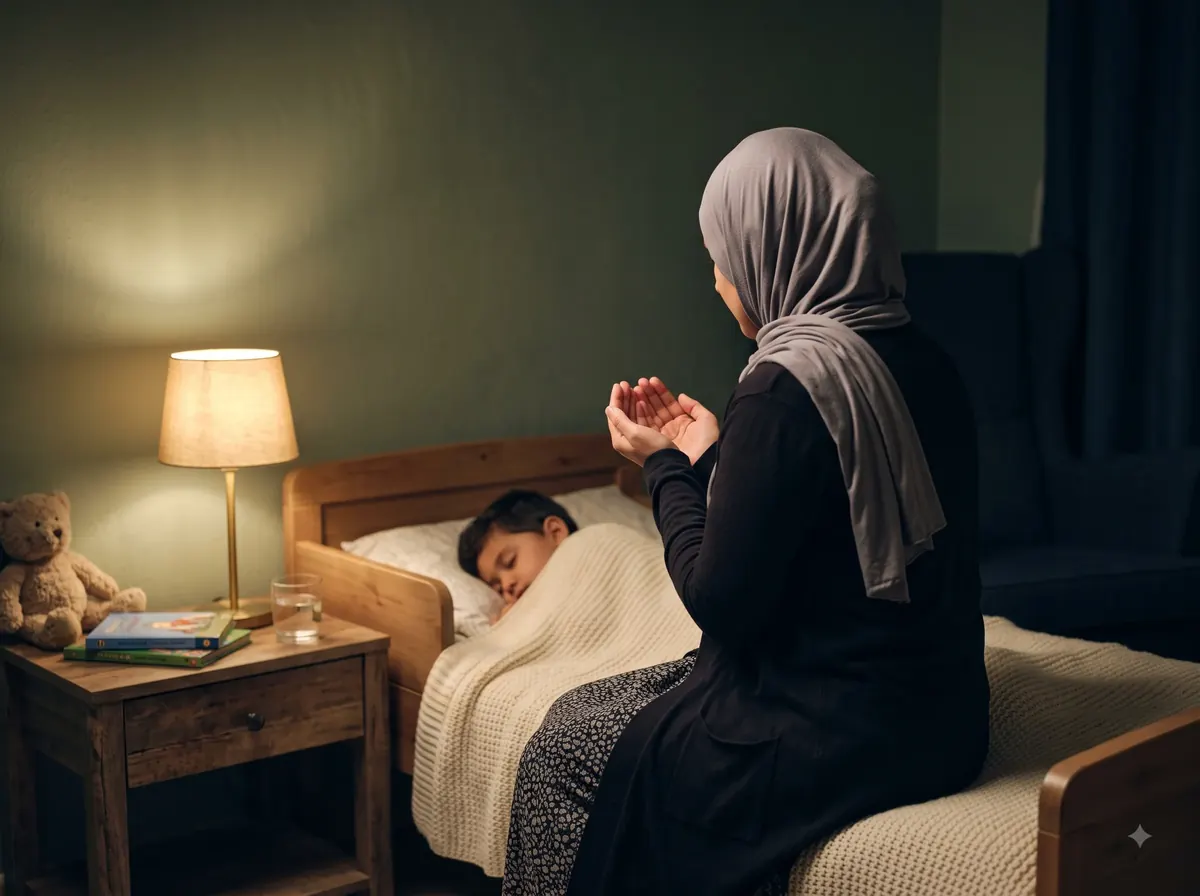
How this is done in practice is simple. The parent recites, sincerely and quietly, and then blows gently over the child or over their own hands and passes them over the child, following the Prophetic practice of reciting and blowing. There is no elaborate ritual and no fixed number of repetitions. Consistency is worth more than intensity. A short daily practice held to for months is a stronger protection than a long recitation attempted once.
One caution is worth stating plainly. Amulets and taweez are not part of authentic ruqyah, and no exceptions are made for their contents. A protective necklace or a folded paper hung on a cot is not a Sunnah protection and should not be treated as one. Our post on ruqyah for evil eye protection deals with the evidence for what is authentic and what is not.
Gentle self-ruqyah at home, and when to involve a Raqi
A parent reciting the Qur'an and Prophetic duas over their child is the daily practice above, and it is the right first response for a Muslim family. It is Sunnah and it is available to everyone. Where a parent wants to know more about how the wider practice of ruqyah works and where its evidence sits, our guide to what ruqyah is according to Islam sets it out in full.
There is a point at which recitation at home is not enough on its own. Where the medical picture has been checked and cleared, where the difficulty in a child has been present for weeks rather than days, where daily protection is being kept up sincerely and the situation is not settling, and where a parent's instinct keeps returning to the same worry, it is right to have a proper assessment. That is what a qualified Raqi does, and it is what a search engine or a well-meaning relative cannot.
If you have reached that point, you can book a one-to-one session and speak to a qualified Raqi about your child's situation directly.
Book your one-to-one Zoom session
Book your one-to-one Zoom session
How we can help
Sessions at Ruqyah Treatment are online over Zoom and strictly one to one, led by qualified Shaykhs. Where a child is the concern, the parent attends the session and we speak with you first: what you are observing, when it began, what the doctor has said, and what has been ruled out already. We assess before we treat, and where we believe the difficulty is medical or psychological we say so plainly and encourage you to keep working with your doctor. We will not ask you for a lock of your child's hair or a piece of their clothing, we will not ask for a mother's name or a date of birth, and we will not hand you an amulet.
What you will be given is a clear picture of your child's situation and a plan you are followed on week by week, so you are never left guessing between sessions. Read more about our private one-to-one ruqyah treatment, or book directly at ruqyahtreatment.com/book-appointment.
Book your one-to-one Zoom session
Book your one-to-one Zoom session
Frequently asked questions
Can the evil eye affect a baby or a young child?
Yes. The Prophet ﷺ said, "The evil eye is real", and Umm Salamah narrated that when he saw a mark on the face of a young girl in her house he instructed that ruqyah be sought for her (recorded in Sahih al-Bukhari). Children are not exempt, and the Sunnah response is protection and, where needed, ruqyah.
What dua did the Prophet ﷺ recite over Hasan and Husayn?
Ibn Abbas narrated that the Prophet ﷺ sought refuge for Hasan and Husayn with the words, "A'udhu bi kalimati'llahi t-tammati, min kulli shaytanin wa hammatin, wa min kulli 'aynin lammah", the same wording Ibrahim (peace be upon him) used for Isma'il and Ishaq. The report is in Sahih al-Bukhari, and parents are on Sunnah to say it over their own children.
أُعِيذُكُمَا بِكَلِمَاتِ اللَّهِ التَّامَّةِ، مِنْ كُلِّ شَيْطَانٍ وَهَامَّةٍ، وَمِنْ كُلِّ عَيْنٍ لَامَّةٍ
“I seek refuge for you both in the perfect words of Allah, from every devil and every crawling creature, and from every envious evil eye.”
- Ibn ‘Abbas · Sahih al-Bukhari
How do I recite ruqyah over my child at home?
Recite Surah al-Falaq, Surah an-Nas, Ayat al-Kursi, and the Prophetic dua for seeking refuge, then blow gently over your child or over your own hands and pass them over the child. Keep the practice short and daily rather than long and occasional, and remember that the effect is by the permission of Allah.
When should I take my child to a doctor rather than to a Raqi?
Always take your child to a doctor first when something is wrong. Ordinary illness, developmental changes, sleep and feeding difficulties, and behavioural changes very often have medical or psychological causes that a doctor is qualified to identify. Ruqyah sits alongside qualified medical care and never replaces it.
Can I bring my child into an online ruqyah session?
For children we normally speak with the parent first and treat the case with the parent in the session. Sessions are online over Zoom and strictly one to one, so the arrangement is discussed at the point of booking and set up in a way that suits the age of the child and what has been observed at home.
A note on medical care
Nothing here is medical advice and nothing here is a diagnosis of any child. Many of the difficulties parents bring to a Raqi have ordinary medical, developmental or psychological causes, and those should always be investigated by a qualified doctor. Ruqyah is a means by which Allah gives healing, and it is practised alongside medical care, never as a replacement for it. Shifa belongs to Allah alone.