
Ruqyah Water: How to Prepare and Use It the Sunnah Way
You have heard people talk about ruqyah water. A glass on the kitchen counter, a bottle in the fridge, a jug carried up to bed. It sounds simple and it more or less is, but it has become a subject where a lot of half-remembered practice has attached itself to a little authentic evidence. This is what ruqyah water is, what the Sunnah actually says about it, how to prepare it and how to use it, so you have the honest picture before you start.
What ruqyah water is, and where it comes from in the Sunnah
Ruqyah water is water that a person has recited the Qur'an, the names and attributes of Allah, and authentic supplications over, then drinks or washes with as a means by which Allah gives shifa. The water is not a treatment in itself. The treatment is the Qur'an. The water carries it in the way that a person carries recitation to themselves after blowing gently over their hands and wiping over their body: a Sunnah way of taking what has been recited to the place it is needed.
The general basis is broad and well established. The Prophet ﷺ recited over the sick and blew, and taught his family to do the same. Aisha, may Allah be pleased with her, narrated in Sahih al-Bukhari that during his final illness he would recite over himself and blow, and when the pain was severe she would recite over him and take his hand to wipe it over him hoping for its blessing. Reciting and blowing, with intention placed on Allah's shifa, is at the heart of every form of ruqyah, whether the medium is the hand, the breath, or water.
The specific evidence for recitation over water goes back to the narration of Thabit ibn Qays, may Allah be pleased with him, when he fell ill and the Prophet ﷺ came to him. Recorded in Sunan Abi Dawud, the report describes the Prophet ﷺ having water brought, reciting over it, and it being poured over Thabit. Scholars have discussed the chain, and the grading is one your Raqi will name for you where he uses it as a specific proof rather than as an example of the general principle. What the report shows, either way, is that reciting over water and using it was a practice known to the Companions.
Ibn al-Qayyim, in Zad al-Ma'ad, includes reciting over water and drinking or washing with it among the Prophetic means of treatment, drawing the general principle from the wider body of narrations rather than from one report alone. If ruqyah itself is new to you, our guide to what ruqyah is according to Islam sets out the evidence and the method in full.
Which surahs and verses to recite over the water
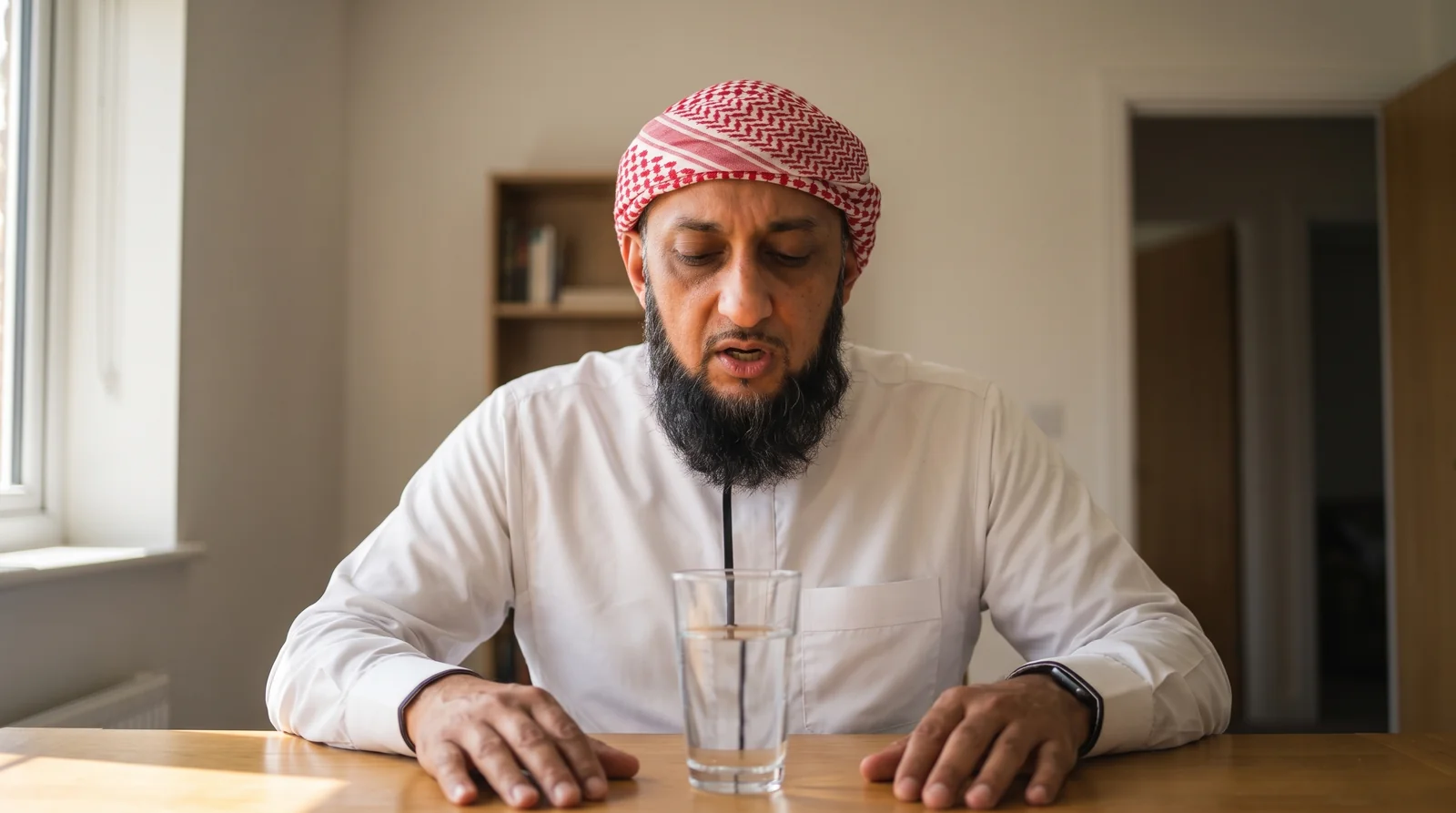
What is recited over ruqyah water is the same body of recitation used in ruqyah generally: the speech of Allah, His names and attributes, and supplications established in the Sunnah. There is no fixed liturgy that must be read word for word, and no verse is assigned to a specific complaint. The following are the recitations most commonly used and each is drawn from the Qur'an or the authentic Sunnah.
- Surah Al-Fatihah, which the Companions themselves used as ruqyah in the well-known incident of the tribe whose chief had been stung, recorded in Sahih al-Bukhari.
- Ayat al-Kursi, Surah Al-Baqarah 2:255.
- The last two verses of Surah Al-Baqarah, 2:285-286.
- Surah Al-Ikhlas, 112.
- The Mu'awwidhatayn: Surah Al-Falaq, 113, and Surah An-Nas, 114. These are the two of seeking refuge, and were the Prophet's ﷺ own recitation over himself at night, as narrated by Uqbah ibn Amir.
- The supplication of the Prophet ﷺ for the sick, "Allahumma Rabban-nas, adhhib al-ba's, ishfi anta ash-Shafi, la shifa'a illa shifa'uk, shifa'an la yughadiru saqaman" ("O Allah, Lord of mankind, remove the harm, cure, for You are the Curer; there is no cure but Your cure, a cure that leaves no illness behind"). Narrated by Aisha in Sahih al-Bukhari.
Selecting what to recite over the water and how much is where the value of a trained Raqi shows. In our own sessions, the recitation is chosen for the person rather than picked from a general list, and it is reviewed as their state changes. For daily household protection, though, the recitations above are what you already have in hand, and they are enough for a person or a family to keep on. Our post on the surahs for protection in Islam gathers them in one place, with the references.
How to prepare ruqyah water
The preparation itself is short and does not need special equipment. Any clean drinking water is suitable. A plain glass or jug is fine, and there is nothing in the Sunnah requiring earthenware, silver, or anything else. Sit somewhere calm with the water in front of you and follow these steps.
- Make wudu if you can, and face the qiblah.
- Begin with "Bismillah" and place your intention on Allah's shifa, not on the water.
- Recite what you have chosen from the list above with presence of heart, not in a rush.
- Blow gently over the water as you recite, in the way the Prophet ﷺ blew when reciting over himself and over the sick. This gentle breath (nafth) is a Sunnah of ruqyah, not a technique of its own.
- Close by turning your face and hope to Allah, asking Him alone for the shifa.
How much to prepare depends on how you plan to use it. A single glass for the same day is enough for most household purposes. A larger jug is fine if a whole family will drink from it. Cover the water and keep it clean, and use it within a reasonable time rather than letting it stand for days. There is no rule that ruqyah water becomes stale spiritually; it becomes stale in the ordinary sense that water sitting out becomes stale.
How to use ruqyah water: drinking, washing, bathing
Ruqyah water has three ordinary uses, and each has a natural setting.
Drinking. A glass in the morning and a glass in the evening is a steady rhythm that fits into the day without effort. It can also be sipped at moments of distress, before sleep, or at the end of the morning and evening adhkar. Say Bismillah and drink calmly.
Washing. Pour a little over the face, the hands and the forearms, or over any part of the body that is unwell, with the intention of Allah's shifa. This is close to the practice described in the narration of Thabit ibn Qays. It is neither a ghusl nor a wudu; it is a wash.
Bathing. A larger amount can be added to a full bath or shower where the person is going through a heavier period of ruqyah, especially under a Raqi's care. This is a form used with judgement, not a routine, and it belongs alongside a proper assessment rather than as a first step on your own.
If your situation has moved beyond what a glass on the counter can hold (persistent signs, a household under strain, or a case that has been going on for months), please do not sit alone with it. A proper assessment through our private one-to-one ruqyah treatment is the honest next step, and ruqyah water then sits inside a plan rather than replacing one.
What to expect, by the permission of Allah
Ruqyah water is a means, and shifa belongs to Allah alone. Ibrahim (peace be upon him) said of his Lord, "And when I am ill, it is He who cures me" (Surah Ash-Shu'ara, 26:80). Allah also said of His book, "And We send down of the Qur'an that which is a healing and a mercy for the believers" (Surah Al-Isra, 17:82). What ruqyah water can be, by the permission of Allah, is a gentle daily support that fits into an ordinary Muslim household: a rhythm of recitation, drinking and remembrance that steadies the heart and the home.
وَنُنَزِّلُ مِنَ الْقُرْآنِ مَا هُوَ شِفَاءٌ وَرَحْمَةٌ لِلْمُؤْمِنِينَ وَلَا يَزِيدُ الظَّالِمِينَ إِلَّا خَسَارًا
“And We send down of the Qur’an that which is a healing and a mercy for the believers, and it does not increase the wrongdoers except in loss.”
— Surah Al-Isra · Qur’an 17:82
وَإِذَا مَرِضْتُ فَهُوَ يَشْفِينِ
“And when I am ill, it is He who cures me.”
— Surah Ash-Shu’ara · Qur’an 26:80
What ruqyah water is not is a quick fix or a substitute for treatment. If what you are dealing with is medical, please see a doctor. If what you are dealing with is spiritual and the signs are persistent, please seek a qualified Raqi. And if you cannot yet tell which of the two it is, that itself is the reason to be assessed, so that you are not months into treating the wrong thing. Our guide on how to perform self-ruqyah at home covers the daily practice, and it is honest about where self-ruqyah reaches its limit.
What to avoid: cultural add-ons and false claims
A lot of what is passed around about ruqyah water is not from the Sunnah. These are the things to leave to one side.
Adding anything to the water for effect. Salt, saffron, oils, black seed, dust from a named place: none of these belong in the preparation as necessary components. What is recited is what carries the ruqyah. Adding items for their own supposed power is a step away from tawheed and towards something else.
Buying ready-made "ruqyah water" from a stranger. You do not know what has been recited over it, whether anything was recited over it at all, or whether other practices have been mixed in. Recite over your own water. It is closer, cleaner, and it is worship.
Numbers, times, and rituals not from the Sunnah. "Recite this exactly seven times at three in the morning while facing east" is not our religion. Recite with presence of heart and use the water at the times that fit an ordinary day.
Amulets around the bottle, ink written into the water, or paper dissolved and drunk. Taweez and their variants are rejected outright, whatever they contain. Our post on taweez and amulets in Islam sets out the evidence.
Book your one-to-one Zoom session
How we can help
Ruqyah water is a modest and honest practice that most homes can carry on their own. Where it belongs inside a bigger plan is where you should not be doing it alone. Our sessions are online over Zoom and strictly one to one, led by qualified Shaykhs. We assess before we treat, we tell you honestly what we find, and where we believe the cause is medical we say so and encourage you to see a doctor.
You will not be handed an amulet, asked for a personal item, or told to buy water. What you will be given is a clear picture of your situation and a plan you are followed on week by week, so ruqyah water and everything else you do at home sits inside a treatment that a Raqi is actually watching. Read more about our private one-to-one ruqyah treatment, or book directly at ruqyahtreatment.com/book-appointment.
Book your one-to-one Zoom session
Frequently asked questions
What is ruqyah water?
Ruqyah water is drinking water that a person has recited the Qur'an, the names and attributes of Allah, and authentic supplications over, then drinks or washes with as a means by which Allah gives shifa. The water is not the treatment; the recitation is. The Sunnah basis is recitation and blowing over the sick, and the practice of reciting over water is reported in Sunan Abi Dawud.
How do I prepare ruqyah water at home?
Take clean drinking water in a plain glass or jug, make wudu if you can, face the qiblah, and place your intention on Allah's shifa. Recite what you know from the Qur'an and the authentic supplications (Al-Fatihah, Ayat al-Kursi, Al-Ikhlas, Al-Falaq and An-Nas are a strong core), and blow gently over the water as you recite. Then use it that day.
What surahs should I recite over ruqyah water?
The recitations most used are Surah Al-Fatihah, Ayat al-Kursi, the last two verses of Surah Al-Baqarah, Surah Al-Ikhlas, and the Mu'awwidhatayn (Surah Al-Falaq and Surah An-Nas). All are from the Qur'an and were used by the Prophet ﷺ or the Companions as ruqyah. No verse is tied to a particular complaint.
How should I use ruqyah water, and can I bathe with it?
The three ordinary uses are drinking, washing a part of the body, and adding a larger amount to a bath. Drinking a glass morning and evening is a steady rhythm. Washing follows the pattern of the narration of Thabit ibn Qays. Bathing in ruqyah water is used with judgement in heavier cases, best done inside a Raqi's plan rather than on your own.
Does ruqyah water guarantee healing?
No. Shifa belongs to Allah alone, and He said, "And when I am ill, it is He who cures me" (Surah Ash-Shu'ara, 26:80). Ruqyah water is a means by which Allah gives healing, not a cure in itself. Use it with presence of heart, alongside medical care where a doctor is needed, and place your hope on Allah.
وَإِذَا مَرِضْتُ فَهُوَ يَشْفِينِ
“And when I am ill, it is He who cures me.”
— Surah Ash-Shu’ara · Qur’an 26:80
A note on medical care
Nothing here is medical advice and none of it is a diagnosis. Many of the difficulties people bring to a Raqi have ordinary medical and psychological causes, and those should be investigated with a qualified doctor. Ruqyah is a means by which Allah gives shifa, and it is practised alongside medical care, never in place of it. Shifa belongs to Allah alone.