
What Happens During a Ruqyah Session? A Step by Step Guide
If you have never attended a Ruqyah session before, it is natural to wonder what to expect. A Ruqyah session usually involves Quranic recitation, authentic supplications, and spiritual guidance based on Islamic teachings. The practitioner recites verses from the Quran while encouraging the individual to place their trust in Allah. Every session is different, and experiences vary from person to person.
Why People Choose Ruqyah
People seek Ruqyah for different spiritual reasons.
Some want spiritual reassurance.
Others want help strengthening their relationship with Allah.
Some seek guidance after learning about the Islamic understanding of the evil eye, envy, or other spiritual concerns.
Whatever the reason, Ruqyah should always be approached as an act of worship rather than a guaranteed solution.
To learn more about Ruqyah itself:
What is Ruqyah According to Islamic Tradition?
Before Your Session
Most practitioners recommend preparing by:
Making a sincere intention
Performing wudu if possible
Choosing a quiet environment
Turning off distractions
There is no special ritual required before a Ruqyah session.
For a detailed guide, read:
How to Prepare for a Ruqyah Session
Step 1 - Introduction
The practitioner will usually begin by:
Introducing themselves
Explaining the process
Answering questions
Making sure you feel comfortable
This helps establish trust and allows you to understand what will happen during the session.
Step 2 - Quranic Recitation

The core of every authentic Ruqyah session is Quran recitation.
Verses commonly recited include:
Ayat ul Kursi
Surah Al Falaq
Surah An Nas
Opening verses of Surah Al Baqarah
Selected authentic supplications
Only Allah brings benefit, and the recitation is performed as an act of worship.
Step 3 - Personal Supplication
The practitioner may make dua asking Allah for:
Protection
Guidance
Mercy
Ease
Comfort
These supplications come from authentic Islamic sources whenever possible.
Step 4 - Advice After the Session
Many practitioners encourage continuing beneficial Islamic practices, such as:
Daily Quran recitation
Morning and evening adhkar
Regular salah
Making dua
Maintaining trust in Allah
These practices support a consistent spiritual routine.
Online vs In Person Sessions
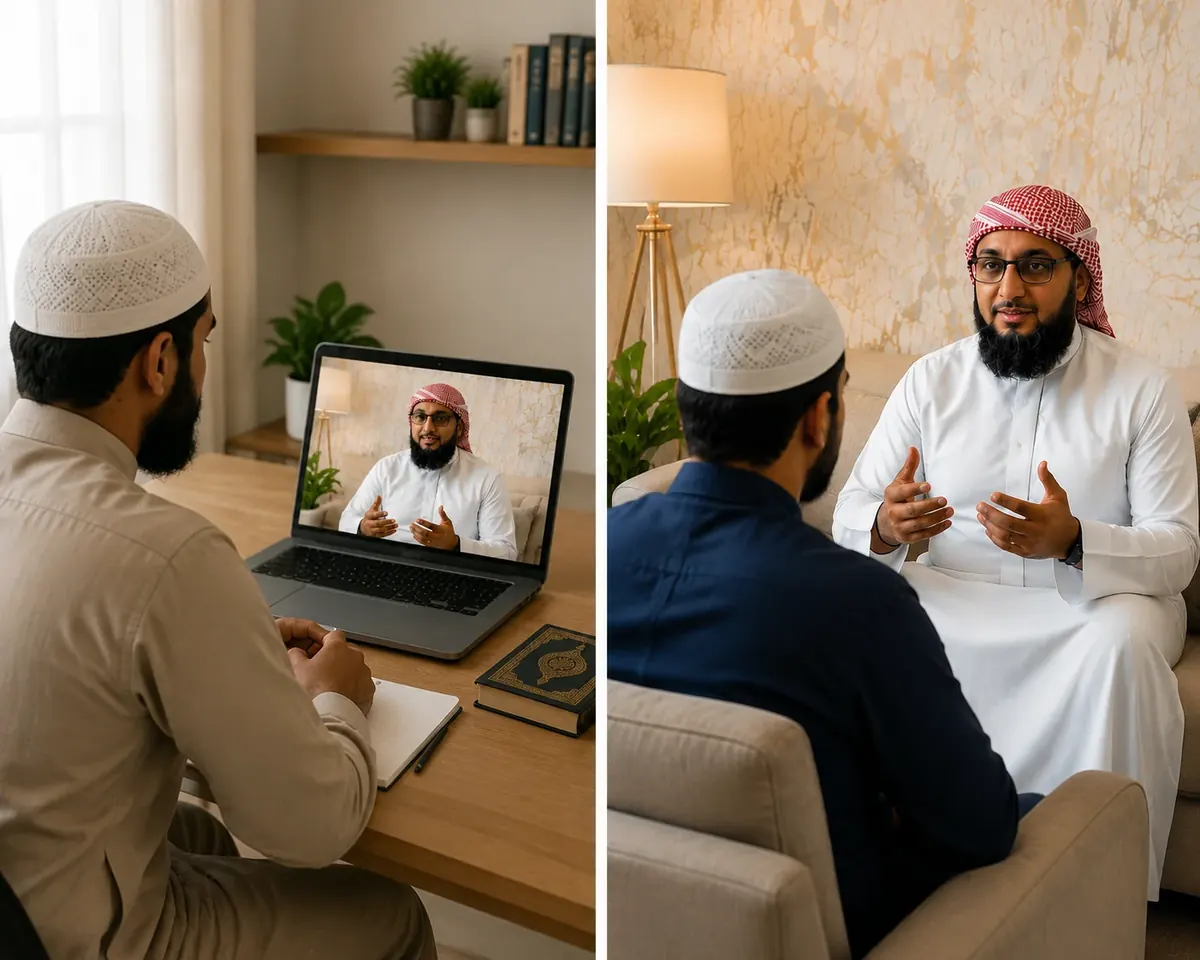
We treated clients in person for a number of years. Over time it became clear that online served people better. Running a clinic from a home carries its own difficulties, and it limits us to whoever can reach us that day. Clients come to us from across the world, and online is simply the more streamlined way to serve them properly, with the same care and the same quality of attention.
It is now a tried and tested method for us. Alhamdulillah, we have seen what Allah has brought about through these sessions, and it is the way we work with every client today. Every session is held online over Zoom, one to one.
People still ask whether online is as effective as sitting in the same room. What carries the effect in Ruqyah is the recitation of the Qur'an and the permission of Allah, not the room. Is Online Ruqyah Permissible in Islam looks at this in full.
What clients tell us they gain from meeting online:
A trained Raqi wherever they live in the world
The comfort of their own home, where it is easier to speak openly
A time that fits their own time zone
If you are ready to experience a session for yourself, you can book a 1-to-1 online Ruqyah assessment, about one hour over Zoom, private and one to one.
How We Can Help
See how an online Ruqyah session works.
Ruqyah Treatment UK has served clients for over 20 years, strictly upon the Qur'an and Sunnah, with no amulets and no superstition.
1-to-1 Ruqyah session, around one hour with an experienced Raqi, held online over Zoom. Book your session.
Wherever you are in the world. All our sessions are online, with appointment times to suit your time zone. We serve clients across the UK, the United States, and worldwide, including many brothers and sisters in America who could not find a trusted Raqi near them.
Group Ruqyah, a live online session every Saturday, a gentle way to begin. Ask about it when you book.
Ongoing care, for those who need structured, longer-term support, ask about the Ruqyah Wellness Plan during your session.
Healing is from Allah alone. Our role is to apply the Qur'an and Sunnah with care, structure, and accountability, and to be honest with you about what you need.
Frequently Asked Questions
How long does a Ruqyah session usually last?
Session length varies depending on the practitioner and the individual's circumstances.
Should I bring anything?
Generally, no. Your practitioner will let you know if anything specific is recommended.
Can family members attend?
This depends on the practitioner's process and your personal circumstances.
Will I feel anything during Ruqyah?
Experiences differ from person to person. Some people notice emotional or spiritual responses, while others may not notice anything immediately.
Can children have Ruqyah?
Parents often seek Ruqyah guidance for children. The approach should always be gentle, age-appropriate, and consistent with Islamic teachings.
Related Articles
Book a Ruqyah Session
If you would like guided Quranic recitation and faith-based spiritual support, you can book a private Ruqyah session with our practitioner.
Explore Related Topics:
How to Perform Self-Ruqyah at Home – Complete Islamic Guide
Can Ruqyah Treat Anxiety and Depression?
How to Prepare for a Ruqyah Session (Islamic Guidance)
Ready to experience it for yourself?
Self-Ruqyah has its limits. Persistent signs need a trained Raqi's assessment. Our sessions are held online over Zoom, one to one, worldwide.