
Ruqyah for Marriage and Relationship Problems: When It Can Help
Every marriage carries its own difficulty. Some seasons are hard because life is hard: work, money, family, tiredness, a new baby, an old wound left to sit too long. Some seasons are hard because two people have grown quiet with one another and neither knows how to speak first. And a small number of marriages carry a difficulty that does not fit any of those, a heaviness that lands between a husband and a wife the moment they are in the same room and lifts the moment they are apart. Ruqyah for marriage is one part of the honest response when that heaviness has a spiritual cause, alongside patience, counselling, and duʿaʾ.
This post is written for a brother or a sister sitting with a marriage that is not right, wanting to know how Islam views what they are living with and what a Muslim couple is actually meant to do. We treat the medical, the emotional, and the spiritual as three real dimensions of one situation, and we say clearly what belongs to each.
Marriage difficulty is not always spiritual, start here
The first honest thing to say is that most marriages in difficulty are not affected by sihr. The Qurʾan describes the marriage bond as a place of tranquillity and mercy that Allah has placed between spouses (Surah Ar-Rum 30:21), and it also acknowledges that spouses drift, that resentment builds, and that difficulty is real. When Allah speaks about serious discord between a husband and a wife, He instructs that arbitrators be appointed, one from his family and one from hers (Surah An-Nisaʾ 4:35). The very first response to marriage difficulty in the Qurʾan is human: bring wise people in, talk honestly, seek reconciliation.
Before anything else, a couple should ask what has actually changed. Was there a loss, a bereavement, a birth, a job move, an addiction, a betrayal, a long silence? Have small habits of resentment gone unaddressed for years? Has one spouse been carrying a mental-health difficulty in silence? A good marriage counsellor, and where relevant a doctor, will help a couple see this clearly. Doing that work is not a lack of faith. It is the same discipline the Qurʾan itself asks for in Surah An-Nisaʾ.
Only after that honest look is it useful to ask whether something spiritual sits on top of the human difficulty as well.
What the Qurʾan says about sihr that separates spouses
Sihr aimed at separating a husband from a wife is not a folk idea. It is named directly in the Qurʾan. In Surah Al-Baqarah, Allah describes the sihr that people learned from the two, "by which they cause separation between a man and his wife" (Al-Baqarah 2:102). The verse continues with the essential qualification that they can harm no one thereby except by the permission of Allah. Both halves of that verse matter. Sihr aimed at spouses is a real thing, named by Allah. And it operates only within what Allah permits, never outside it.
فَيَتَعَلَّمُونَ مِنْهُمَا مَا يُفَرِّقُونَ بِهِ بَيْنَ الْمَرْءِ وَزَوْجِهِ
“They learn from them that by which they cause separation between a man and his wife.”
— Surah Al-Baqarah · Qur’an 2:102
The Prophet ﷺ himself was affected by sihr, as narrated by ʿAʾishah and recorded in Sahih al-Bukhari and Sahih Muslim through the well-known incident involving Labid ibn al-Aʿsam. The Prophet's ﷺ response was to turn to Allah in duʿaʾ and to recite the Muʿawwidhatayn, the two Quls, Surah Al-Falaq and Surah An-Nas, which include the refuge from "the evil of the blowers upon knots" (Al-Falaq 113:4), a direct reference to a form of sihr. The Sunnah answer to sihr is the words of Allah and duʿaʾ, not counter-sihr, not amulets, not going to another practitioner who claims to "reverse" it.
Signs that can point to sihr in a marriage
Signs are what a trained Raqi looks for in a session, drawn from twenty years of practice. They are not a checklist for a reader to score their own marriage against. We list them here so a sister or a brother knows what is worth mentioning at an assessment, not to hand anyone a diagnosis.
What we see in sessions where sihr targeted at the marriage is present:
- A sudden aversion between a couple that has no story behind it, appearing over days or weeks with no argument, no incident, no drift.
- An inability to be in the same room, a physical restlessness or agitation that lifts as soon as the spouses are apart.
- Recurring dreams of a specific kind, often involving snakes, water, or a figure standing between the couple.
- A persistent physical response to Qurʾanic recitation in the home, headaches, nausea, or agitation when protective surahs are read regularly.
- Intimacy affected suddenly and without medical cause, once medical causes have been properly investigated by a doctor.
- A recurring pattern of one spouse remembering the other in a false and hardened way, seeing faults where there are none, or forgetting years of shared life.
None of these on its own is proof. Any of them can have a medical or psychological cause. All of them together, over time, with medical causes ruled out and marriage counselling attempted honestly, is what tends to bring a couple to a Raqi.
If several of these are sitting in the room and you have already done the human work, an assessment with a qualified Raqi is the responsible next step. We do that assessment in a structured Zoom session, one to one, and we tell you plainly what we do and do not observe.
If this is where you are, a one-to-one Zoom assessment is the honest next step, ninety minutes with a qualified Raqi to look at the situation carefully. Book a one-to-one assessment, or read our guide to the signs of sihr and how ruqyah addresses it.
Never accuse anyone
Do not accuse a mother-in-law, a sister-in-law, an old friend, a business rival, or anyone else. Ever. The Qurʾan places the harm of sihr under the permission of Allah, and it places the sin of a false accusation squarely on the tongue of the accuser. A marriage held together with suspicion of a named person becomes a second harm on top of the first.
Do not go to any practitioner who offers to "name the person", to "reverse the magic", or to write a taweez to bind or unbind. All of this is outside the Sunnah, and the practices are rejected in the Prophetic guidance. Amulets are rejected outright in the Sunnah, whatever a practitioner claims is inside them. If someone tells you they can identify the source of the sihr by naming a family member, walk away and tell your Raqi what you were told.
How authentic ruqyah addresses marriage-affecting sihr
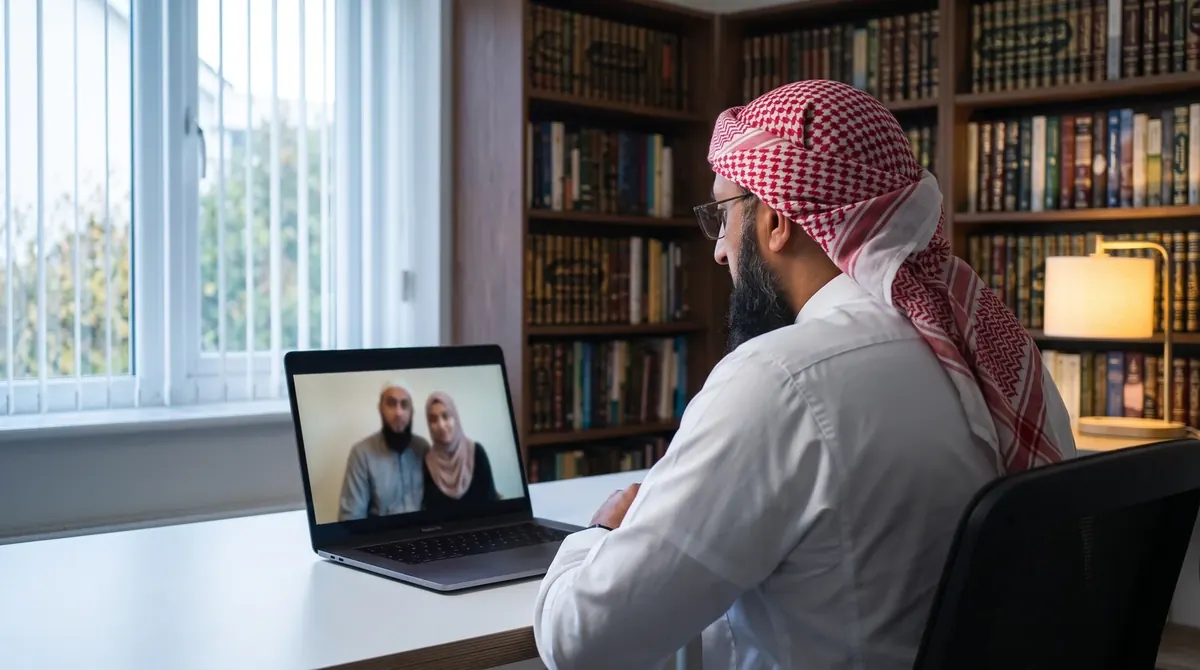
Our method is Qurʾan-based. Sessions are online over Zoom, strictly one to one with the affected spouse, and structured across a diagnosis, a treatment plan, and follow-up. Where the situation involves both spouses, we assess them separately and coordinate care, because the private nature of a session and the honesty it requires are protected by keeping it one to one. This is not a compromise on togetherness, it is the same standard we apply to every case.
A first assessment looks at the spiritual, emotional, and physical picture together. If sihr targeting the marriage is present, the treatment involves sustained recitation of protective surahs by the Raqi over the client, guidance on daily recitation and adhkar the client takes home, and, where suitable, the personalised listening prescription of Qurʾanic recitation recorded in our own studio that is central to our Wellness Plan. Progress is followed and reviewed week by week, with a weekly written check-in and a weekly recorded video review from the client's Raqi. You are not left guessing between sessions.
We do not promise a number of sessions before or after assessment. Ruqyah is not a fixed science and no one can honestly say in advance how long a case takes. What we offer is structure, honesty, and steady care.
Duʿaʾ and lawful steps a couple can take
Alongside seeking help, a Muslim couple has real work of their own to do, and that work matters whether the situation turns out to be sihr or not:
- Daily morning and evening adhkar, together where possible. The Muʿawwidhatayn, Surah Al-Falaq and Surah An-Nas, along with Ayat al-Kursi (Al-Baqarah 2:255), are protective and grounding. Reciting the Qurʾan in the home softens the atmosphere by the permission of Allah.
- Duʿaʾ for anxiety and grief, as taught by the Prophet ﷺ, is a great mercy in a marriage under strain. "Allahumma inni aʿudhu bika min al-hammi wal-hazan" and its full form is narrated in Sahih al-Bukhari from Anas ibn Malik. It settles the heart.
- Return to remembrance of Allah in the home. "Verily, in the remembrance of Allah do hearts find rest" (Ar-Ra'd 13:28). Ten minutes of Qurʾan aloud in the living room every day changes the state of a household over weeks.
- Marriage counselling from a qualified counsellor, ideally one familiar with Muslim family life. This is not opposed to ruqyah, it works alongside it. Serious relational patterns need relational work.
- Medical care where relevant, honestly and without shame, from a qualified doctor. Depression, thyroid problems, hormonal shifts, and other conditions can mimic parts of what people ascribe to sihr. Rule these out properly.
- Ṣalāh together and duʿaʾ for one another. A spouse who prays for their spouse by name in the last third of the night is doing something no counsellor and no Raqi can do for them.
None of this is a substitute for a proper assessment when it is needed. It is the ground the assessment stands on.
Book your one-to-one Zoom session
How we can help
If your marriage is in a season you cannot explain, and the human work is not moving it, book a one-to-one Zoom assessment. Ninety minutes with a qualified Raqi, structured across the three dimensions we work with, at the end of which you will have a clear plan and honest words about what we did and did not observe. Sessions are online over Zoom, worldwide, strictly one to one, in English with Urdu, Gujarati, and Hindi accommodated on request.
You can read more about what ruqyah is according to Islam, our approach through private one-to-one ruqyah treatment, and the wider picture of sihr and how ruqyah addresses it.
Book your one-to-one Zoom assessment
Frequently asked questions
Can ruqyah save a marriage that is failing?
Ruqyah is a means, not a source. Shifāʾ belongs to Allah alone. Where sihr is affecting a marriage and the couple is willing to do the human work as well, ruqyah can be a real part of the response, by the permission of Allah. It is not a magic reset for a marriage where the difficulty is not spiritual, and no honest Raqi will present it that way.
Should a husband and wife do ruqyah together in one session?
No. Sessions are strictly one to one, for the honesty and privacy they require. Where both spouses want support, we assess them separately and coordinate care around them. This is not a compromise, it is how the treatment works properly.
How can I know if our marriage problems are sihr or ordinary difficulty?
You cannot know from a checklist, and neither can we from a form. That is what a proper assessment is for. Do the human work first: honest conversation, counselling, medical care where relevant. If several unusual signs remain after that, book a one-to-one Zoom assessment and we will look at it carefully with you.
Is it wrong to seek marriage counselling alongside ruqyah?
Not at all. The Qurʾan itself instructs the appointment of arbitrators in serious marital discord (An-Nisaʾ 4:35). Counselling and ruqyah address different dimensions of the same situation, and doing both is a stronger response than either alone.
Can we recite Qurʾan at home ourselves for the marriage?
Yes, and you should. Daily recitation of Ayat al-Kursi and the Muʿawwidhatayn, along with the morning and evening adhkar, is protective for a household by the permission of Allah. Self-recitation has real limits when serious sihr is present, though. Persistent signs need a trained Raqi's assessment.
A medical note
Marriage difficulty often carries mental-health and physical-health strain: sleep loss, anxiety, low mood, physical symptoms. None of this is a failure of faith. See a qualified doctor and, where appropriate, a mental-health professional. Ruqyah supports, it never replaces, medical care.